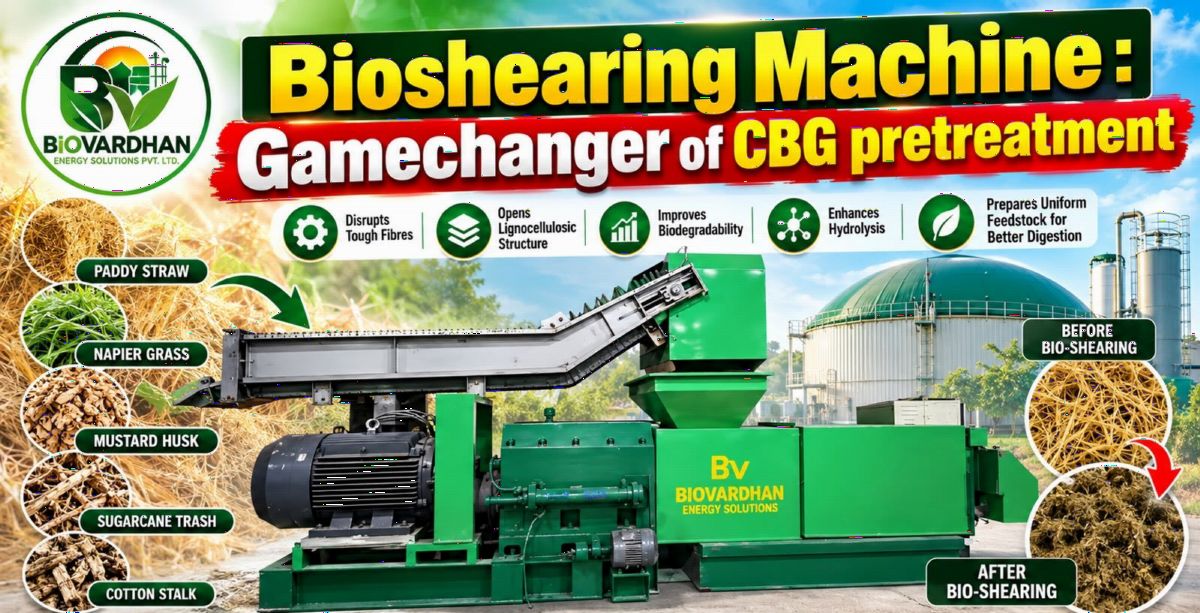
Short answer: a bio-extruder is a twin-screw pretreatment machine that tears open the tough fibres in paddy straw, Napier grass and other crop residue before they go into a CBG digester. You will also hear it called a biomass extruder, biogas extruder or bio-shearing machine. A shredder only makes straw smaller. A bio-extruder opens it up, so the bacteria in the digester can actually get to the food inside.
If you are planning a CBG plant on agri-residue, this is one of the machines that decides whether your digester runs smoothly or fights you every day. Here is how it works, why it matters and what to check before you buy one.
Why do paddy straw and Napier grass need pretreatment?
Crop residue is cheap and available in huge quantities across India. The catch is its structure. The cellulose and hemicellulose that produce biogas sit locked inside a hard layer of lignin. Bacteria struggle to break through it.
When straw goes into a digester after simple chopping, plant teams usually run into the same problems:
- Long fibres wrap around agitators and choke feed systems
- Particle size varies, so feeding is uneven
- Light straw floats and forms a scum layer on top of the digester
- Hydrolysis is slow, so the material needs longer retention
- Pumps, mixers and conveyors wear out faster
In plain terms, you get less gas from every tonne you buy, and more maintenance. Good pretreatment solves this before the biomass ever reaches the digester.
What does a bio-extruder do?
A bio-extruder sits in the pretreatment line after the shredder and hammer mill. Inside it, two intermeshing screws grip the biomass and put it through intense shearing, compression, mixing and fibre opening. Water is added as the process needs.
The key word is fibrillation. A chopper or hammer mill cuts straw into shorter pieces. A bio-extruder pulls the fibre bundles apart and breaks their structure. That exposes much more surface area to water, enzymes and bacteria.
Is a bio-extruder the same as a bio-shearing machine?
Yes. Different suppliers use different names for the same idea: bio-extruder, bioextruder, biomass extruder, biogas extruder, twin-screw extruder for biomass, twin-screw shearing machine and bio-shearing machine. All of them describe a screw machine that shears and opens biomass fibres before digestion. At Biovardhan we call ours a bio-extruder, because that is the name most plant owners search for.
How does a bio-extruder work, step by step?
- Feeding: a conveyor brings shredded or milled biomass into the hopper at a steady rate.
- Shearing and compression: the twin screws squeeze and shear the material as it moves forward.
- Fibre opening: repeated shearing splits the fibre bundles and breaks the lignocellulosic structure.
- Moisture conditioning: water is added in a controlled way so the biomass mixes evenly.
- Uniform discharge: a soft, even, easy-to-handle material comes out, ready for slurry preparation and the digester.
What are the benefits for a CBG plant?
1. It disrupts tough fibres
Stiff fibres are torn open, not just cut. They stop tangling around agitators and feed screws.
2. It opens the lignocellulosic structure
Breaking the lignin–cellulose shell lets microbes reach the digestible material inside.
3. It improves biodegradability
More exposed surface means a larger share of the biomass is available for anaerobic digestion.
4. It speeds up hydrolysis
Hydrolysis is usually the slowest step when you digest crop residue. Opened, wetted fibres break down faster and more evenly.
5. It gives the digester a uniform feed
A consistent feed keeps the digester biology stable, reduces floating layers and makes daily operation calmer.
Which feedstocks can a bio-extruder handle?
- Paddy straw (parali): see our paddy straw CBG plant guide
- Napier grass: see our Napier grass CBG plant guide
- Mustard husk and mustard residue
- Sugarcane trash
- Cotton stalk
- Wheat straw and maize stalk
Where does it fit in a CBG pretreatment line?
A typical pre-CBG line for crop residue runs like this: bale shredder → hammer mill → bio-extruder → slurry preparation / hydrolysis → anaerobic digester.
Each machine has one job. The shredder opens the bales. The hammer mill evens out the size. The bio-extruder does the fibre opening that makes the biomass truly digestible. You can see the full chain on our bio-extruder and biomass pretreatment page.
Bio-extruder vs shredder vs chaff cutter: what is the difference?
Shredding changes size. Extrusion changes structure.
A chaff cutter or shredder gives you shorter straw, but each piece is still a closed bundle of fibres. A hammer mill makes the size more even, but the fibre is still closed. A piece that has been through a bio-extruder is opened, wetted and much easier for bacteria to attack. That is why plants running on agri-residue invest in proper pretreatment instead of relying on choppers alone.
One honest note: research on extrusion pretreatment of straw and grass has reported better biogas output than untreated material, but how much it helps on your plant depends on your feedstock and your digester process. It should be checked and validated for each plant.
What should you check before buying a bio-extruder?
- Your feedstock: paddy straw is abrasive and high in silica, while Napier is wet and stringy. The machine has to suit yours.
- Wear parts and spares: screws and liners wear over time, so ask about spare availability and lead time.
- Throughput: capacity should match your daily feedstock in TPD, with some headroom.
- Power per tonne: compare energy use per tonne processed, not just motor size.
- Integration: it must connect cleanly with your conveyors, slurry system and plant controls.
- A trial on your biomass: ask to see the machine run on your actual feedstock.
Who makes bio-extruders for CBG plants in India?
Spares and service matter as much as the machine itself, so a local manufacturer helps. Biovardhan Energy Solutions manufactures bio-extruders in-house in Kota, Rajasthan. Our covered manufacturing infrastructure of about 125,000 sq. ft. is used for agitators, bio-extruders, FOM machinery and plant components.
Because we build the machine and also deliver the complete CBG plant as an EPC contractor, we design the pretreatment line around your feedstock and digester. It is not picked from a catalogue. Learn more about us as a CBG plant manufacturer.
Frequently asked questions
What is a bio-extruder used for in a biogas plant?
It opens the fibres of crop residue such as paddy straw and Napier grass so they digest faster and more completely, and so they feed smoothly without floating or tangling.
Do I still need a shredder if I install a bio-extruder?
Usually yes. Baled straw is first opened by a bale shredder and evened out by a hammer mill. The bio-extruder then does the fibre opening.
Does a bio-extruder increase biogas production?
Pretreatment that opens fibres and increases surface area generally helps digestion of crop residue. The actual gain depends on the feedstock and the digester, so it should be validated for each plant.
Can one bio-extruder handle both paddy straw and Napier grass?
It can be set up for different feedstocks, but paddy straw and Napier behave very differently. The machine and its settings should be chosen for the main feedstock of your plant.
Get a pretreatment recommendation for your feedstock
Tell us your feedstock, how many tonnes per day you have and your target CBG capacity. Our engineers will suggest the right bio-extruder and pretreatment line for it. Call or WhatsApp +91 92519 91977, email info@biovardhanenergy.com, or send us an enquiry.
Published 15 October 2026 by Biovardhan Energy Solutions Pvt. Ltd. · More articles