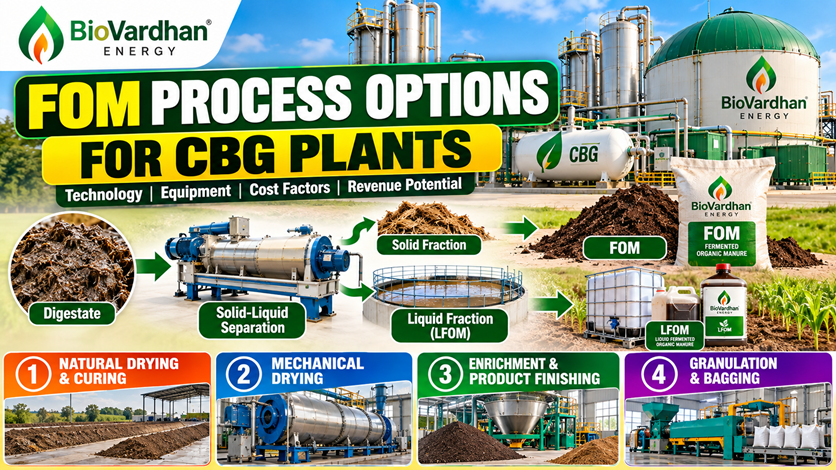
Short answer: FOM (Fermented Organic Manure) is made from the digestate left after a CBG plant has taken the gas out of the biomass. The usual route is: separate the digestate into solid and liquid, dry or cure the solid part, finish it to a set quality, test it and pack it. The liquid part becomes LFOM, goes back into the process, or gets treated. Which machines you need depends on your digestate, your land, your climate and who will buy the manure.
Most CBG plant owners spend months choosing the digester and the upgrading unit, and a week deciding what to do with the digestate. Then the plant starts, and they find out it produces hundreds of cubic metres of wet slurry every single day. Plan FOM early and it becomes a second income. Leave it late and it becomes a daily headache.
What is FOM in a CBG plant?
When bacteria in the digester break down organic matter, they produce biogas. What is left over is digestate: water, undigested fibre and nutrients. That digestate cannot be sold as it is. It has to be processed into a product that meets the fertiliser rules.
It is usually split into two streams:
- Solid fraction: dried or cured, enriched if needed, screened and packed as FOM.
- Liquid fraction: sold as LFOM, partly reused in the plant, or treated.
What does a complete FOM processing line look like?
For the solid side, a typical line runs like this: digestate → solid-liquid separation → drying or curing → enrichment (if needed) → screening → quality testing → packing.
The liquid side runs separately: liquid fraction → storage and treatment → LFOM, reuse in the plant, or further treatment.
Not every plant needs every step. A plant whose separator gives a fairly dry cake needs far less drying than one producing a wet, fibrous cake. A plant with spare land in a dry region might dry naturally, while a plant with little space or heavy monsoon rain will probably need a mechanical dryer.
Step 1: How is digestate separated into solid and liquid?
Separation is almost always the first real step. It turns one difficult slurry into two streams that are much easier to handle.
The common machines are:
- Screw press separator: squeezes liquid out of fibrous digestate. Choose it based on fibre content, throughput and how dry you need the cake.
- Decanter centrifuge: spins the solids out. Good separation, but check power use and maintenance.
- Filter press: pushes the slurry through filter cloths. Works in batches, so check cycle time and cake handling.
- Screw press followed by filter press: two stages, for when you need a drier cake or cleaner liquid.
These machines are not interchangeable. Digestate from paddy straw behaves very differently from digestate from cattle dung or press mud. Before you buy, find out your digestate's total solids, particle size, daily volume and the cake moisture you need.
The best advice we can give: get real digestate samples and run a separation trial before you fix the machine size. A separator chosen from feedstock tonnage alone often fails to deliver the cake dryness you expected.
Step 2: Natural drying or a mechanical dryer?
Natural drying and curing
If you have land and a dry climate, you can spread the separated solids on a drying yard or form them into windrows and let the sun and air do the work.
What you need:
- A paved or concrete drying yard
- Equipment to move the material
- A windrow turner or mixer, if needed
- Drains and leachate collection
- Covered storage for the finished product
- Screening and bagging equipment
It uses little energy and is simple to run. The downsides are just as real: it needs a lot of land, drying time depends on the weather, rain can stop it completely, and you have to control odour, runoff and leachate. Natural drying does not mean leaving digestate in an open field. The yard, drainage and handling have to be designed properly.
Mechanical drying
When land is short, or you cannot depend on the weather, a dryer does the job faster and more predictably. Rotary dryers suit continuous drying of bulk solids. Paddle dryers suit some indirect-drying applications. Other industrial dryers are chosen for specific products.
Before you choose a dryer, work out:
- Solid throughput in tonnes per day
- Moisture going into the dryer
- Moisture you need coming out
- The heat source available and what it costs
- Dust control and exhaust treatment
- Handling and storage
- Whether you will sell in bulk, in bags or as granules
Waste heat from the plant can make drying much cheaper, but check the temperature, the amount of heat, the running hours and the heat exchanger before you count on it. A dryer should be sized from a moisture and energy balance, not from a tonnes-per-day guess.
Step 3: Does FOM need enrichment and finishing?
After drying or curing, the material may need finishing to meet a product specification. That can include blending with permitted additives, controlled enrichment, mixing, screening for even particle size, granulation, quality testing and bagging.
Enrichment is not needed in every plant. Do it only when you are making a specific product with a buyer in mind. Phosphate enrichment to make PROM (Phosphate Rich Organic Manure) is a common example.
Quality matters most here. The final product must meet the Fertiliser Control Order (FCO) and other rules. That covers moisture, organic carbon, pH, electrical conductivity, nutrients, pathogens and contaminant limits. Not every dried digestate automatically qualifies as FOM. Testing, product classification and buyer acceptance have to be sorted out before you dispatch your first load.
Step 4: Is granulation and bagging worth it?
Some plants turn their FOM into granules: processed FOM → size reduction (if needed) → mixing → granulation → drying (if needed) → screening → packing.
Granules look more uniform, are easier to handle and pack into standard bag sizes. Some distribution channels may prefer them.
But granulation adds machines, power, maintenance and complexity. It does not automatically raise your selling price or create demand. Before investing, confirm who will buy the product, what specification they want, how much they will take and whether the numbers still work after processing and transport.
What should you do with the liquid fraction?
The liquid side needs a plan too. There are three broad options:
- Make LFOM: the liquid can be treated and sold as Liquid Fermented Organic Manure, subject to the rules. You will need storage, filtration, quality control and a way to pack or dispatch it.
- Recycle it into the process: some liquid can go back into slurry preparation. How much depends on the water balance, dissolved solids, ammonia and alkalinity. Recycle too much and the digester can suffer.
- Treat it further: whatever cannot be sold or recycled has to be treated to meet discharge rules, designed around your actual water balance.
For paddy straw plants, the liquid fraction is a big part of the water and recirculation strategy. Design its handling together with the digester, not as an afterthought after commissioning.
Which FOM option is right for your plant?
A quick comparison:
- Natural drying and curing: needs more land and is highly weather dependent, but uses less energy and simpler equipment. The main costs are land, time and handling.
- Mechanical drying: needs less land and does not depend on the weather, but uses more energy and more complex equipment. The main costs are heat and dryer efficiency.
- Enrichment and granulation: gives a defined, finished product, but adds energy and complexity. The main questions are product demand, formulation and processing cost.
There is no single best option. Many plants use a mix, such as mechanical dewatering followed by natural drying, or mechanical drying followed by granulation. The final choice should come from a technical and financial assessment of your own project.
How do you estimate how much FOM a plant will produce?
Use a mass balance, not a fixed percentage of the feedstock. You will need:
- Daily digestate quantity
- Digestate total solids
- Separator performance
- Cake moisture after separation
- Dry matter lost during processing
- Moisture of the final product
- Material rejected at screening
A simple version, assuming the dry solids stay the same:
- Dry solids = wet cake × (1 − cake moisture)
- Final FOM = dry solids ÷ (1 − final moisture)
Example: a plant makes 10 tonnes a day of solid cake at 70% moisture. That is 10 × 0.30 = 3 tonnes of dry solids. If the finished FOM has 40% moisture, the plant makes 3 ÷ 0.60 = 5 tonnes of FOM a day.
This is only an illustration of the method, not a production promise. Your real output depends on measured plant data. You can get a first estimate of feedstock and output with our CBG feedstock and yield calculator.
What decides whether FOM makes money?
Look at FOM separately from CBG revenue. The basic sum is simple: yearly saleable FOM × the price you actually get.
The number that really matters is what is left after costs: FOM revenue minus processing, packing, storage, handling, transport and marketing. Then add the cost of handling the liquid fraction and any stock you cannot sell.
The main cost items are:
- Separator power and maintenance
- Drying energy
- Labour and material handling
- Enrichment additives
- Granulation and bagging
- Testing and compliance
- Storage and working capital
- Transport and distribution
One warning: a quoted selling price does not mean you can sell your whole output at that price. Your financial model should separate bulk and bagged sales, nearby and distant buyers, and contracted and open-market sales. Try to get buyer interest or an offtake agreement before you put FOM revenue into the project report.
Is there government support for FOM and LFOM in India?
Yes. Under the Market Development Assistance (MDA) scheme, the government pays ₹1,500 per tonne for eligible FOM, LFOM and PROM made by biogas and CBG plants under the GOBARdhan umbrella. According to a Press Information Bureau release from March 2026, 120 CBG and biogas plants were registered on the iFMS fertiliser portal as of 4 March 2026.
Do not assume you will get it automatically. A new national CBG scheme was approved in August 2026, so check the current status, registration conditions, product specifications and paperwork with the Department of Fertilizers before you count the support in your numbers.
How can Biovardhan help?
At Biovardhan we treat digestate as part of the plant design, not as waste to deal with later. We manufacture FOM machinery in-house in Kota, Rajasthan, and design the digestate line together with the digester and water system. Depending on your project, the scope can include:
- Solid-liquid separation
- FOM drying and curing
- LFOM handling and processing
- Material handling and screening
- Enrichment and finishing
- Granulation and bagging
- Integration with the plant's water and digestate strategy
See our FOM and LFOM digestate solutions, or read more about us as a CBG plant manufacturer.
Frequently asked questions
What is the difference between FOM and LFOM?
FOM is the solid organic manure made from the separated, dried or cured solid part of the digestate. LFOM is the liquid part, treated and sold as liquid organic manure.
Which separator is best for CBG digestate?
There is no single best machine. A screw press suits fibrous digestate, a decanter centrifuge gives finer separation, and a filter press can give a drier cake. Run a trial on your own digestate before you decide.
How much FOM does a CBG plant produce?
It depends on the digestate quantity, its solids content, the separator and the final moisture. It must be worked out with a mass balance for your plant, not taken as a fixed percentage of feedstock.
Do I need a dryer for FOM?
Not always. If you have land and a dry climate, natural drying can work. If land is short or monsoon rain is heavy, a mechanical dryer gives more reliable output.
Planning FOM for your CBG project?
Tell us your feedstock, your plant capacity and where the plant is. We will suggest the right FOM and LFOM route for it. Call or WhatsApp +91 92519 91977, email info@biovardhanenergy.com, or send us an enquiry.
Published 16 October 2026 by Biovardhan Energy Solutions Pvt. Ltd. · More articles