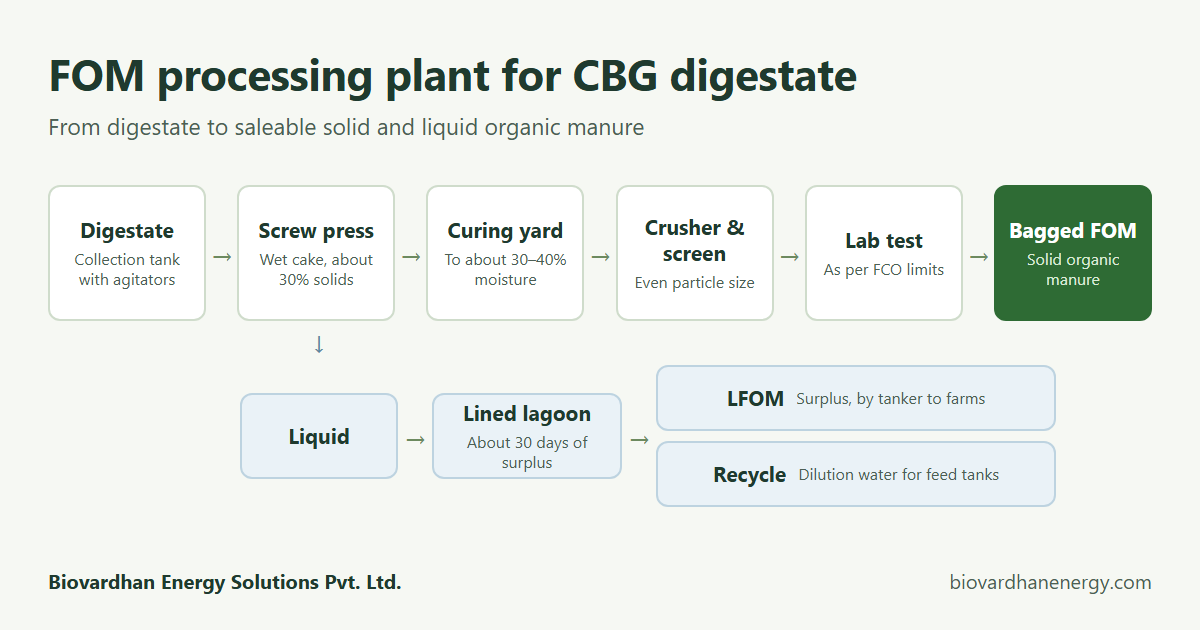
Short answer: FOM processing turns the digestate from a CBG plant into solid organic manure you can sell. The digestate goes through a screw press, the cake is cured to about 30–40% moisture, then crushed, screened, tested and bagged. A 5 TPD plant on Napier grass produces about 21 tonnes of wet cake a day, which becomes about 10 tonnes of cured FOM. On paddy straw the output is much higher, at about 33 tonnes of cured FOM a day.
We design CBG plants for a living, and FOM is the part most project reports treat too lightly. It gets one line in the revenue table and very little land on the layout. Then the plant starts, the cake piles up, and the first monsoon shows what was missed. Here are the numbers we use when we plan this section. For an overview of drying and separation choices, see our guide to FOM process options.
How much FOM does a CBG plant produce?
The feedstock decides most of it. These are planning figures from our project models, per day:
100% Napier grass
- 3 TPD: about 13 t of wet cake, or 6 t of cured FOM
- 5 TPD: about 21 t of wet cake, or 10 t of cured FOM
- 10 TPD: about 42 t of wet cake, or 19–20 t of cured FOM
- 20 TPD: about 84 t of wet cake, or 38–40 t of cured FOM
100% paddy straw
- 3 TPD: about 20 t of cured FOM
- 5 TPD: about 33 t of cured FOM
- 10 TPD: about 66 t of cured FOM
- 20 TPD: about 130 t of cured FOM
Wet cake here means about 30% solids, straight from the press. Cured FOM means about 35% moisture. The sum is simple: 21 t × 30% solids = 6.3 t of dry matter, and 6.3 ÷ 65% = about 10 t of FOM.
Always check which of the two figures a supplier is quoting. "21 tonnes of FOM a day" and "10 tonnes of FOM a day" can describe the same plant, and the difference is mostly water. Your own numbers will depend on your feed, so test it and run it through our TS and VS calculator first.
What machines does a FOM processing plant need?
In the order the material moves:
- Digestate collection tank with agitators. It keeps the solids suspended and gives the press a steady feed.
- Screw press separators with feed pumps. A 5 TPD Napier plant handles about 275 t of digestate a day, so two 10 m³/hr presses can do it in about 14 hours and leave a margin for cleaning.
- Conveyor to the curing yard. Loading cake by hand gets expensive and messy quickly.
- Paved curing yard with a windrow turner. Turning lets air in and controls heat and smell.
- Hammer mill or crusher, then a trommel screen. Fibrous cake needs this step. It is often skipped in early plans.
- Enrichment mixer (optional). For example, rock phosphate to make PROM. Add it when you have a buyer for that product.
- Bagging machine and covered store. Bulk sale to nearby farms may need less of this.
Granulation is a further option. It adds power, maintenance and cost, so confirm that a buyer will pay for granules before you add it.
How much land does FOM curing need?
More than most layouts allow. As a starting estimate, a 5 TPD Napier plant curing for 2–3 weeks needs about 1,000–1,500 m² of paved yard with drains. Add about 300–500 m² of covered store for a month of stock. A paddy straw plant has far more material to handle, so size its yard from its own mass balance.
The yard needs a concrete floor, a slope to a leachate sump, and a roof over at least part of it. Rain falling on open windrows washes out nutrients and stops the curing. Leachate goes back into the process.
Our estimates assume a dry-season curing rate. If your site has a long monsoon, enlarge the covered area, or plan a dryer for those months.
Should you use a dryer, and can biogas run it?
Only when the land or the climate forces you to. Here is the reason. Taking a 5 TPD Napier plant's cake from 21 t to 10 t removes about 11 t of water a day. At roughly 900–1,000 kcal per kg of water in a real dryer, that is about 1.05 crore kcal a day. Using raw biogas, it would burn about 1,900 Nm³ a day, about a sixth of what the plant makes. Each of those Nm³ could have been sold as CBG.
A dryer starts to make sense with free waste heat, for example from a nearby boiler or engine. Calculate the heat balance before you buy one.
What quality must FOM meet to be sold?
FOM and LFOM are sold under the Fertiliser Control Order. A February 2025 amendment, S.O. 897(E), brought in a category called "organic carbon enhancers from Compressed Bio Gas plants".
The checks we plan for are:
- Moisture of about 30–40% after curing
- Total organic carbon of at least 14%
- pH of 6.5–8.4
- Conductivity of not more than 4 dS/m
- Declared N, P₂O₅, K₂O and C:N ratio
- Heavy metal limits and no pathogens
Take the final limits from the FCO text in force when you register, and test at a notified laboratory. Rules in this area have changed several times.
Two problems come up repeatedly. Down To Earth reports that FOM often falls short on minimum NPK, and that fibrous FOM from agricultural residues fails the 4 mm sieve requirement. Both trace back to the feed. So test a digestate sample early, and budget for the crusher and screen if your feed is grass or straw.
What should you do with the liquid part?
Most of the digestate leaves the press as liquid. In a 5 TPD Napier plant, about 253 t a day goes to the lagoon. About 173 m³ of it returns to the feed tanks as dilution water, and about 80 m³ is left over as LFOM.
Farmers will not take liquid manure every day, and field use stops during heavy rain. So plan a lined lagoon for about 30 days of surplus, which is about 2,400 m³ at this size. Also line up enough farmland within tanker distance before you commit, and watch ammonia and salts in the recycled liquid, because too much can upset the digester.
Paddy straw plants make far less surplus LFOM, about 4–5 m³ per TPD against about 16 m³ for Napier, because dry straw brings very little water into the plant.
How much income can FOM bring?
Work it out from what you actually keep after costs. On a 5 TPD Napier plant running 330 days, you would have about 3,200 tonnes of cured FOM a year. That gives you a simple rule:
- Every ₹1,000 per tonne of net realisation is about ₹32 lakh a year.
Net means the selling price minus curing, bagging, testing, storage, transport and marketing. Market rates vary widely by region and buyer, so use written quotes from real buyers rather than a price from a brochure. In our own project reports we take a cautious ₹1,000 per tonne for FOM and ₹100 per kilolitre for LFOM.
Then there is Market Development Assistance of ₹1,500 per tonne on eligible FOM, LFOM and PROM. On 3,200 tonnes, that could be up to about ₹48 lakh a year. Treat it as an upside, for three reasons:
- It requires FCO-compliant product and registration on the GOBARdhan portal, so check the conditions for your sales route, whether through a fertiliser marketing company or direct to farmers.
- It is assistance, not your selling price.
- Scheme terms change, so confirm the current position with the Department of Fertilizers before you put it in a bank model.
As of March 2026, the government reported 120 CBG and biogas plants registered on the iFMS portal and 44 MoUs with fertiliser marketing companies. Speak to these companies before your plant is built.
Five common mistakes in FOM planning
- Quoting wet cake tonnage at a cured FOM price
- Leaving no covered storage for the monsoon and the off-season, when farmers are not buying
- Leaving out the crusher and screen on a fibrous feed
- Sizing the LFOM lagoon for a few days instead of a few weeks
- Starting to look for buyers after commissioning
Frequently asked questions
How much FOM comes from 1 tonne of CBG?
On Napier grass, about 4 tonnes of wet cake, or about 2 tonnes of cured FOM. On paddy straw, about 6–7 tonnes of cured FOM.
How much FOM does a 5 TPD CBG plant produce?
About 10 tonnes of cured FOM a day on Napier grass (from about 21 tonnes of wet cake), and about 33 tonnes a day on paddy straw. These are planning figures, and a test on your own feed will refine them.
What is the difference between FOM and LFOM?
FOM is the solid manure made from the pressed and cured cake. LFOM is the liquid part of the digestate left after some of it is recycled to the feed tanks.
Can digestate be sold without processing?
Not as a fertiliser product. To sell it as FOM it has to meet FCO limits, which means separating, curing and testing it. Plants that cultivate their own Napier can also use FOM and LFOM on their own fields.
How long does FOM curing take?
Plan for about 2–3 weeks on the yard in dry weather, and up to 4–8 weeks if you are running a full windrow composting stage. It depends on the season, turning frequency and starting moisture.
Is a screw press enough for CBG digestate?
For fibrous digestate from straw or Napier, it usually is. A decanter or filter press may be needed for finer, low-fibre digestate such as food waste. Run a trial with your own sample.
Planning FOM for your CBG plant?
We design the FOM and LFOM section together with the digester and the water balance, so land, storage and machines are sized from the start. See our FOM and LFOM digestate solutions, or share your feedstock, capacity and location on +91 92519 91977 or info@biovardhanenergy.com.
Published 3 November 2026 by Biovardhan Energy Solutions Pvt. Ltd. · More articles