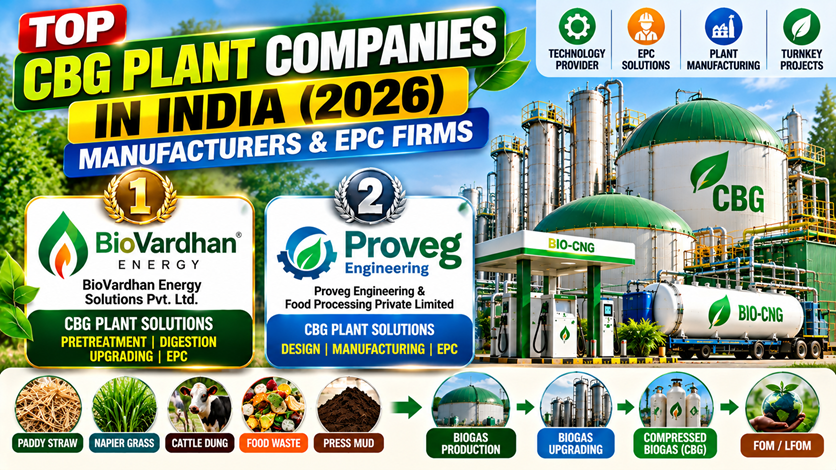
Short answer: India has a handful of companies that can deliver a complete CBG (Bio-CNG) plant, and many more that supply one part of it. Biovardhan Energy and Proveg Engineering build and supply plants for agri-residue and organic waste. GPS Renewables, Praj Industries and CEID Consultants are larger EPC and technology players with commissioned projects. EverEnviro develops and operates its own plants, and Mailhem Ikos specialises in organic-waste biomethanation. The right choice depends on your feedstock, plant size and how much of the project you want one company to own.
Disclosure: this guide is published by Biovardhan Energy. We have listed ourselves first and Proveg Engineering second. The others are listed in no particular order, based on what they have said publicly. This is not an audited ranking, so verify every claim directly before you shortlist anyone.
If you are planning a CBG plant, choosing the plant company is one of the biggest decisions you will make. A wrong choice shows up later as a digester that never reaches its gas target, an upgrading unit that wastes methane, or a contract where nobody owns the problem. Here is who is in the market and how to compare them.
What does a CBG plant company actually do?
A complete CBG plant has four parts, and companies differ in how many of them they cover:
- Pre-CBG: feedstock handling, shredding and pretreatment such as a bio-extruder
- Digestion: digesters, agitators, heating and gas collection
- Gas cleaning and compression: H₂S removal, CO₂ upgrading, drying, compression to about 250 bar and cascade filling
- Post-CBG: digestate separation into FOM and LFOM
Some companies are EPC contractors who take responsibility for all of it. Some are technology providers who license a process or supply one key system. Some are developers who build, own and operate plants themselves. Know which one you are talking to before you compare prices.
1. Biovardhan Energy Solutions Pvt. Ltd.
Biovardhan Energy, based in Kota, Rajasthan, is a CBG and Bio-CNG plant manufacturer and turnkey EPC contractor for plants from 3 to 20+ TPD. We work on a Pre-CBG + CBG + Post-CBG model: prepare the feedstock properly, produce and upgrade the gas, then turn the digestate into saleable manure.
What we cover:
- Pretreatment: bale handling, shredding, hammer milling and our in-house bio-extruder for paddy straw and Napier grass
- Digestion: CSTR digesters, in-house agitators, gas collection and storage, automation
- Gas cleaning and compression: H₂S and moisture removal, CO₂ upgrading, compression, cascades and gas-quality monitoring
- Digestate: solid-liquid separation, FOM and LFOM processing, plus biochar and pellet options
We manufacture agitators, bio-extruders and FOM machinery in-house, from about 125,000 sq. ft. of covered manufacturing space. That means local spares and faster service after commissioning. Read more on our CBG plant manufacturer page.
Good fit for: projects on paddy straw, Napier grass, cattle dung, press mud and mixed agri-residue, where pretreatment and feedstock engineering decide whether the plant performs.
2. Proveg Engineering & Food Processing Pvt. Ltd.
Proveg Engineering is an Indian engineering and machinery company working across biomass processing, food processing and industrial plants. Its CBG plant offering covers the main stages of turning organic feedstock into compressed biogas, and it stresses designing the plant around the feedstock you actually have.
What to look at:
- CBG plant engineering and machinery
- Processing of agricultural residue and organic waste, including hammer mills for size reduction
- Anaerobic digestion, gas purification and compression
- Modular layouts sized to feedstock availability
- Digestate handling and organic fertiliser options, through its biofertilizer plants
- Related biomass plants for biomass pellets and biochar
Good fit for: investors who want CBG machinery and integrated engineering for agri-residue and organic waste. Learn more about Proveg Engineering or contact Proveg.
3. GPS Renewables
GPS Renewables is a Bengaluru-based bioenergy company with commissioned CBG plants. It reported its third CBG plant, in Panipat, as operational in February 2024, and its project list includes a paddy-straw plant in Barabanki, Uttar Pradesh, listed at 20 TPD CBG. It uses its own biogas upgrading technology and has formed a joint venture with Indian Oil for bioenergy projects.
Good fit for: large, industrial-scale CBG projects, especially on agri-residue, where a proven track record at scale matters most.
4. Praj Industries
Praj is a Pune-based process engineering company best known for ethanol. For CBG it offers RenGas, its own technology for producing CBG from rice straw and press mud. Praj won an order from HPCL in 2021 for a rice-straw CBG project at Badaun, Uttar Pradesh, and has worked on a press-mud CBG project with Leafiniti Bioenergy in Karnataka.
Good fit for: sugar mills, distilleries and large investors who want a technology-led partner with a big engineering organisation behind it.
5. CEID Consultants and Engineering
CEID is a Chennai-based Bio-CNG EPC company. It says it has commissioned more than 30 Bio-CNG projects across 15 states. In 2025 Indraprastha Gas Limited (IGL) signed a 50:50 joint venture with CEID for CBG and biofuel projects.
Good fit for: developers who want an experienced EPC contractor for multi-feedstock Bio-CNG plants, including smaller institutional projects.
6. EverEnviro Resource Management
EverEnviro is mainly a developer and operator, not an equipment supplier. It runs a large municipal-solid-waste CBG plant in Indore under a public-private partnership with the Indore Municipal Corporation, and it began CBG production at two press-mud plants in Uttar Pradesh in 2024.
Good fit for: municipalities, sugar mills or landowners looking for a partner who will invest in and operate the plant, rather than a contractor who hands over the keys.
7. Mailhem Ikos Environment
Mailhem Ikos is a Pune-based company focused on anaerobic digestion of organic waste. Its technology is a modified UASB process for waste with high suspended solids. It reports a 15 TPD Bio-CNG plant for Indore Smart City, running on segregated municipal organic waste.
Good fit for: municipal and food-waste projects. If your feedstock is fibrous crop residue, confirm their experience with it.
8. Regional EPC contractors and specialist suppliers
Beyond these names, India has many regional contractors and specialists: digester builders, upgrading and compressor suppliers, pretreatment machine makers, automation firms and FOM equipment suppliers. A regional supplier can be the right choice when you need local fabrication, quick service or one specific technology. Just be clear about who is responsible for the interfaces between them.
How do you shortlist a CBG plant company?
Ask every company to quote on the same feedstock, capacity, gas specification and scope. Then check:
- Feedstock experience: have they built a plant on your exact feedstock?
- Capacity proof: do they have a commissioned plant at your size?
- Pretreatment: is the line right for fibrous straw or Napier, or only for slurry?
- Digestion: digester volume, retention time, mixing and heating
- Upgrading: methane purity, methane recovery and compliance with IS 16087
- Compression: pressure and delivery route (cascade, CGD or captive)
- FOM and LFOM: separation, product quality and a sales plan
- Utilities: power, heat, water and chemicals, ideally as kWh per kg of CBG
- EPC scope: one contractor clearly responsible for engineering, procurement, construction and commissioning
- Performance guarantee: test conditions, guaranteed outputs and penalties if the plant underperforms
- After-sales: operator training, spares, maintenance and response time
Our CBG plant quotation checklist walks through these line by line.
How much does a CBG plant cost in India?
There is no single price. Cost depends on capacity, feedstock, pretreatment, digester design, upgrading technology, compression, land development, utilities, civil work and how much of the scope the EPC company takes on. A fibrous agri-residue plant needs heavier pretreatment than one running on easily digestible waste.
Compare these separately in every quotation:
- Capital cost (CAPEX)
- Feedstock purchase and transport
- Electricity and heat
- Manpower and maintenance
- Digestate processing and sales
- Working capital and financing
- Commissioning and performance testing
A low equipment price does not mean a low lifetime cost. For indicative budgets by size, see our CBG plant cost in India guide.
What is the difference between CBG and Bio-CNG?
In India, CBG (Compressed Biogas) and Bio-CNG mean the same thing: biogas upgraded to high methane purity and compressed for use as fuel. The process is the same: prepare the feedstock, digest it, remove H₂S and moisture, remove CO₂, test the gas, compress it, and process the digestate. See our Bio-CNG plant page for the details.
Which CBG plant company should you choose?
- Agri-residue projects (paddy straw, Napier): pick a company with proven pretreatment for that exact feedstock.
- Large industrial projects: weigh track record, engineering depth and contractual guarantees.
- Smaller or regional projects: look at service access, simple operation and lifetime cost.
- Turnkey projects: make sure one named contractor owns the whole scope, including the interfaces between digestion, upgrading, compression and utilities.
The best partner is the one that shows you a sound design, realistic gas-yield numbers, transparent costs, clear guarantees and reliable service, not simply the lowest quotation.
Frequently asked questions
Who are the main CBG plant manufacturers in India?
Companies active in CBG include Biovardhan Energy, Proveg Engineering, GPS Renewables, Praj Industries, CEID Consultants, EverEnviro and Mailhem Ikos, along with many regional EPC contractors and equipment suppliers. Their roles differ, from equipment supply to full EPC to building and operating plants.
What is the difference between a CBG EPC contractor and a technology provider?
An EPC contractor takes responsibility for engineering, procurement, construction and commissioning of the whole plant. A technology provider licenses a process or supplies one key system, such as upgrading, and you or another contractor integrate the rest.
How do I check if a CBG plant company is reliable?
Visit a plant they have commissioned on your feedstock, speak to that plant's owner, and ask for actual operating data: daily CBG output, methane purity, power use and downtime. Then compare guarantees in the contract, not just in the brochure.
Which company is best for a paddy straw CBG plant?
Choose one with proven straw pretreatment, a commissioned straw-based plant and a clear mass balance. Paddy straw is the hardest common feedstock to digest, so pretreatment experience matters more than price. See our paddy straw CBG plant guide.
Planning a CBG or Bio-CNG plant?
Talk to us about your feedstock, plant size, process design, CBG output and digestate plan. Biovardhan Energy, Kota, Rajasthan. Call or WhatsApp +91 92519 91977, email info@biovardhanenergy.com, or send us an enquiry.
Published 17 October 2026 by Biovardhan Energy Solutions Pvt. Ltd. · More articles