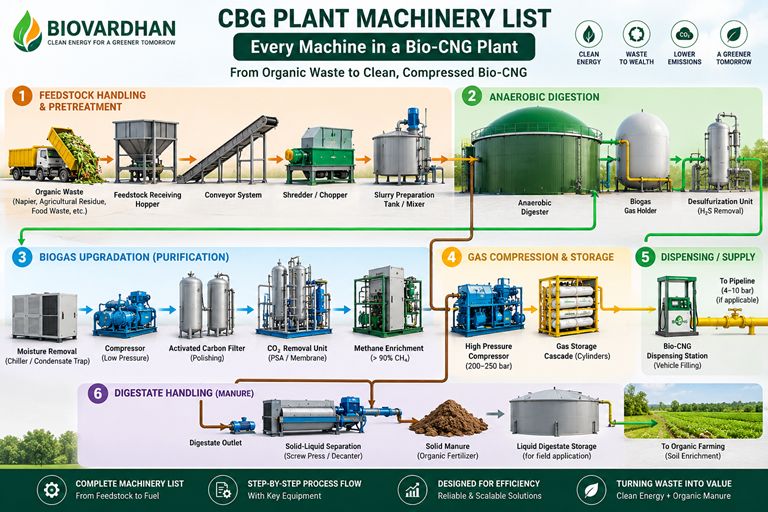
Short answer: A CBG (Bio-CNG) plant needs machinery in eight sections: feedstock receiving, pretreatment (shredder and bio-extruder), feeding and hydrolysis tanks, anaerobic digesters with agitators, gas holders, gas cleaning and CO₂ upgrading, high-pressure compression with cascade filling, and digestate processing into FOM and LFOM. A 5 TPD plant on Napier grass or paddy straw typically has one large RCC digester of about 32 m diameter, a 500–600 Sm³/h upgrading unit and a 250 bar compressor. The machines that decide whether the plant actually reaches its rated output are the pretreatment line, the digester mixing and the spare capacity in the gas train.
We build and commission CBG plants in India, and we review a lot of quotations from other suppliers for our clients. This list is written from that work. It covers every machine a working plant needs, what size each one should be, and where buyers most often get short-changed.
What machinery does a CBG plant need?
Think of a CBG plant as three plants joined together:
- Pre-CBG: receiving, storing and preparing the feedstock so microbes can digest it
- CBG: digesting the feed into biogas, then cleaning, upgrading and compressing that gas to 250 bar
- Post-CBG: turning the leftover digestate into solid and liquid organic manure
Here is the machinery in each section, in the order the material flows.
1. Feedstock receiving and storage
Every tonne that enters the plant is weighed, stored and fed at a steady rate. Gas output follows the feed, so this section matters more than it looks.
- Weighbridge of 40–60 tonnes, with load cells and ticketing software
- Silage bunkers for Napier grass, or a covered bale yard for paddy straw, sized for several months of stock
- Front-end loaders and tractor trolleys to move feed to the line (usually the owner's scope)
A 5 TPD plant on Napier grass needs roughly 100 tonnes of fresh grass a day. On paddy straw, it needs about 45–55 tonnes of dry straw a day, and a full year of straw has to be baled and stored within a few weeks of harvest.
2. Pretreatment machinery: shredders, bio-extruders and conveyors
Paddy straw and Napier grass are fibrous. If the fibre is not opened up, the digester takes much longer to break it down, floating crusts form, and gas yield drops. This is why pretreatment is the first place to look when you compare suppliers.
- De-baler or bale breaker to open square or round bales, usually with a variable-speed drive
- Double-shaft shredder to cut straw to 10–20 mm. Typical lines run at 4–8 tonnes per hour with 150–200 HP of installed motors
- Bio-Extruder (twin-screw biomass pretreatment machine), which shears and fibrillates the shredded material and takes Napier grass below 5 mm. Units of 3–5 tonnes per hour with 100–150 HP main motors are common. Read more in our guide to the bio-extruder for CBG plants
- Hammer mill with cyclone and bag filter, where very fine size is needed for dry straw
- Stone and metal separator to protect the pumps and agitators downstream
- Chevron belt conveyors with variable-speed drives linking each machine
A common mistake in quotations is a single pretreatment machine that has to run 20 hours a day to handle the rated feed. Size the line so it does the day's feed in one or two shifts, with time left for maintenance.
3. Feeding and hydrolysis (pre-treatment) tanks
Shredded feed is mixed with recycled liquid from the digestate to make a pumpable slurry of about 10% solids.
- Pre-treatment or hydrolysis tanks with top-entry or submersible agitators
- Feed hoppers and screw feeders for metered dosing
- Progressive-cavity or screw pumps to move thick slurry into the digester
- Recycle-liquor pumps from the lagoon, so the plant needs almost no fresh process water once it is running
4. Anaerobic digesters and agitators
This is the heart of the plant, and the biggest single cost along with upgrading.
- CSTR digesters (continuously stirred tank reactors), usually RCC slipform tanks of 26–36 m diameter and 11–12 m height, insulated and run at 38–40 °C
- Side-entry propeller agitators that keep thick fibrous slurry moving. Imported Italian units are often specified for Napier and straw plants
- Axial-flow mixing pumps that draw slurry from the bottom and return it to the top, breaking any floating layer
- Scum-breaking nozzles on the surface
- Internal hot-water coils fed by a hot water generator
- Level, temperature and pressure instruments, view glasses and a GI walkway
How to check digester size: divide the working volume by the daily slurry flow. That is the hydraulic retention time (HRT). For Napier grass and paddy straw, it should be about 30–35 days or more. We have seen quotations that state 35 days when their own numbers work out to 32, or that add straw to the feed without increasing the digester at all. Do this one division yourself before you trust any offer.
5. Gas holders
- Double-membrane gas holder on top of each digester (a ¼-sphere dome). The inner membrane stores biogas; an air blower keeps the outer membrane tight against wind and rain
- Ground-mounted purified-gas buffer holder before the compressors, so they run smoothly
- Pressure/vacuum safety valves and condensate traps
6. Gas cleaning and CO₂ upgrading
Raw biogas is about 55–59% methane, saturated with water, and contains hydrogen sulphide (H₂S). It has to reach at least 96% methane, below 3 ppm H₂S and a dew point of −65 °C to meet IS 16087 for CBG.
- Moisture traps and chiller to dry the gas
- H₂S removal by a biological or chemical scrubber, plus activated-carbon polishing
- CO₂ upgrading by VPSA (vacuum pressure swing adsorption): compact and cost-effective for 3–6 TPD plants
- CO₂ upgrading by hollow-fibre membrane: modular, well suited to 10 TPD and above
- CO₂ upgrading by water scrubbing: simple and robust where water is plentiful
- Online gas analyser for CH₄, CO₂, H₂S and O₂, with automatic recycling of off-spec gas
- Automatic flare sized for the full raw-gas flow, for start-up and emergencies
Sizing rule we use: a plant needs about 2.3 Nm³ of raw biogas per kg of CBG. The upgrading unit should have 10–20% headroom over peak raw-gas flow. An upgrading unit running at 96% of its rating on day one has no room for a good feed day, and that gas ends up in the flare.
7. Compression, filling and dispatch
- High-pressure reciprocating compressors that raise purified gas to 250 bar
- Intercoolers, separators and relief valves, in a PESO-compliant shed with a blast wall
- Multi-bay fill post with a custody-transfer mass flow meter and mercaptan odorisation
- Mobile cascades (Type-1 cylinders on a truck) for dispatch to oil-company outlets or industrial buyers, or a pipeline connection to a city gas network
Check the compressor count. If a 5 TPD plant has one compressor running at 90% load and no standby, one breakdown stops all CBG sales until it is repaired. Two smaller compressors, or one plus a standby, cost more but protect your revenue.
8. Digestate handling: FOM and LFOM machinery
About 3–4 tonnes of solid manure come out for every tonne of CBG.
- Digestate collection tank with agitators
- Screw-press separators (or a decanter) to split solids from liquid
- FOM processing: windrow turner, dryer, screen, granulator and bagging machine for fermented organic manure
- LFOM lagoon and pumps; part of the liquid is recycled to the feed, the rest goes to farms
FOM is a real second income. See our guide to FOM process options for CBG plants.
9. Utilities, controls and safety
- Transformer and HT connection (typically 630 kVA for 3 TPD up to 2,500 kVA for 15 TPD), MCC panels and an APFC panel
- PLC/SCADA with an operator station and remote access
- Water softener for the hot water generator
- Fire water tank, pump house (electric, diesel and jockey pumps), hydrants and gas detectors
- Laboratory with a gas chromatograph and moisture and H₂S analysers
How does the machinery scale with plant size?
These are typical figures from our own standard designs for Napier grass plants. Your feedstock and site will change them.
- 3 TPD: 1 digester of about 26 m × 11 m; VPSA of about 300 Sm³/h; one 250 bar compressor; around 5,600 kWh of power a day; about 60 tonnes of Napier grass a day
- 5–6 TPD: 1 digester of 32–36 m diameter; VPSA of 500–650 Sm³/h; one or two compressors; 8,900–11,300 kWh a day; 100 tonnes of Napier grass, or a Napier and straw mix
- 10 TPD: 2 digesters of about 32 m × 11 m; membrane upgrading of about 1,000 Nm³/h; two or three compressors; around 17,000–18,000 kWh a day
- 15 TPD: 3 digesters of about 32 m × 11 m; membrane upgrading of about 1,500 Nm³/h; three or more compressors; around 25,000 kWh a day
For budgets, see our CBG plant cost guide and the detailed pages for the 5 TPD CBG plant and 10 TPD CBG plant. To estimate gas from your own feedstock, try the CBG feedstock yield calculator.
Which machines decide whether a CBG plant works?
Most CBG plants that struggle do not fail because of a missing machine. They fail because of a few machines that are the wrong size. In our experience, five things matter most:
- Pretreatment capacity and particle size. Under-sized shredding or extrusion means coarse feed, crusts and lower gas.
- Digester retention time and mixing. Too small a digester or weak agitation for fibrous slurry caps your output permanently. A tank cannot be enlarged later.
- Headroom in upgrading. Without 10–20% spare capacity, you flare gas on good days.
- Compressor redundancy. One compressor without a standby is a single point of failure for all revenue.
- A mass balance that matches the feed. If a quotation leaves the feed quantity blank, or shows the same slurry and gas figures for "Napier only" and "Napier plus straw", the design was copied, not engineered.
Our CBG plant quotation checklist walks through these checks one by one.
Made in India or imported: what should you buy where?
Most CBG plant machinery is now made well in India: shredders, bio-extruders, conveyors, tanks, pumps, agitators, FOM machines, fabricated piping and structures. Buying these locally shortens lead times and makes spares easy to get.
A few items are commonly imported or bought from specialist makers: high-speed side-entry digester agitators for very fibrous feed, membrane modules for upgrading, and some high-pressure compressor models. What matters is not where a machine comes from, but whether one company is responsible for the whole plant reaching its output.
How Biovardhan supplies CBG plant machinery
As a CBG plant manufacturer and turnkey EPC company, Biovardhan manufactures the parts of the plant that decide how well it handles difficult feedstock: bale shredding and hammer milling lines, the Bio-Extruder, digester agitators and mixing systems, and FOM processing machinery. Gas holders, upgrading units and high-pressure compressors come from established specialist makers and are integrated by our engineering team. Everything is delivered under one EPC contract, from feedstock testing and design to commissioning, the performance test and operator training.
Frequently asked questions
What is the main machinery in a CBG plant?
The main machinery is a feedstock pretreatment line (shredder and bio-extruder), anaerobic digesters with agitators, double-membrane gas holders, a gas cleaning and CO₂ upgrading unit, high-pressure compressors with a cascade filling station, and screw-press separators with FOM processing machines.
How much does CBG plant machinery cost?
Plant and machinery are usually about 55–65% of a full-scope CBG project budget, with civil works making up most of the rest. For Napier grass and agri-residue plants, a full 5 TPD project is indicatively ₹25–40 crore excluding GST and land. The exact figure depends on feedstock, upgrading route and site conditions.
Which upgrading technology is best for a CBG plant?
VPSA is usually the most economical for 3–6 TPD plants. Membrane upgrading suits 10 TPD and larger plants because it is modular and compact. Water scrubbing works well where water is easy to get. All three can meet the IS 16087 CBG specification when the gas is properly pre-cleaned.
What machine is used to pretreat paddy straw for a CBG plant?
Paddy straw is opened with a bale breaker, cut in a double-shaft shredder and then sheared in a bio-extruder (also called a bio-shearing or biomass pretreatment machine). Some plants add a hammer mill. Good pretreatment shortens digestion time and raises biogas yield from fibrous feed.
How big is the digester in a 5 TPD CBG plant?
On Napier grass, a 5 TPD plant typically uses one RCC CSTR digester of about 32 m diameter and 11 m height, with about 8,000 m³ of working volume. Plants that add paddy straw or want a longer retention time need a larger digester.
Do I need a standby compressor in a CBG plant?
It is strongly recommended. With a single compressor and no standby, any breakdown stops all CBG dispatch until it is repaired. Two compressors, or one running plus one standby, keep the plant earning during maintenance.
Planning a CBG plant? Share your feedstock, location and target capacity through our CBG project questionnaire or contact us, and we will send a machinery list and layout sized for your project.
Published 26 October 2026 by Biovardhan Energy Solutions Pvt. Ltd. · More articles